CENTRAN SABACC
Designers:
Source Material - L. Neil Smith (Lando Calrissian Adventures)
GOTG Version - Mike Correy
Playtesters:
Adrian Berger, Shoya Haa'runi, Kenzie, Rick Scott, Margherita Casciadi, Helen Casciadi
THE COMPLETE CENTRAN SABACC
Centran Sabacc is the precursor of Classic Sabacc. It is named for it’s association with the popular Oseon Flamewind tournaments held in the Centrality Sector. As an older form, Centran has taken on something of an archaic or aristocratic air akin to Empress Teta Preferred, but it is still a mainstay amongst traditionalists and legacy casinos. It is distinguished by three core elements:
First, Centran Sabacc used an earlier form of the Sabacc deck, an ‘Oracle’ style deck used for telling fortunes. The Centran or Oracle style deck had 78 cards rather than the 76 cards used in Classic. This was an older and more ancient form of Sabacc, which the alien species known as the Ryn claim to have invented for fortune-telling and prophecy.
Second, Centran used a more dynamic Sabacc Shift mechanism. In digital and electronic games, card shifts are triggered automatically and can occur at any time, affecting a random number of cards in the deck and the player's hands. In table games, a card draw mechanic is used to determine the timing of a shift and the number of cards affected.
The third element of Centran was the Wild Fives, a special rule for all of the '5' value cards in the deck which added a unique layer of strategy to hand management in this variant.
Navigate our Complete Guide to Centran Sabacc:
Under Rules - A complete breakdow of the game, including table setup, game components, gameplay structure and order, win and loss conditions, hierarchies and tables.
Under Sources - Documented sources for Centran Sabacc in the Star Wars, including the Expanded Universe/Legends, Disney Canon, including published materials and merchandise.
Under Downloads - Player Resources for playing Centran Sabacc. Download a copy of the rules.
RULES FOR CENTRAN SABACC
Centran Sabacc is an advanced variant of Sabacc that uses an older style of Sabacc deck with 78 cards. This deck is based on old fortune telling decks. The game uses positive and negative cards across 5 suits, and involves strategic betting and card selection to achieve the optimal hand.
Hand strategy is also heavily weighted by the effect of the Wild Fives rule, which states that all cards with a value of 5 must be played to the table, and factored into all player hands, with the optional value of 5, -5 or 0.
GOAL
The objective is to assemble a hand with a total value of -23, +23 or 0. Any of these scores is a Pure Sabacc and is eligible to win the Sabacc Pot.
THE SETUP
Draw Deck: A Centran Sabacc deck comprises 78 cards. The deck has four primary suits of 14 cards: Coins, Flasks, Sabers and Staves.
Each of the main suits contains:
Ranked Cards: Valued from 2 to 10
Face Cards: The Legate (11), Commander (12), Mistress (13), Master (14), Ace (1 or
15)

Additionally there is a special suit (The Major Aspect Suit) of 22 Aspect cards which have negative or nuetral values.
The Idiot has a value of 0. The rest of the cars are valued -1 to -21. They will have different names between different decks (depending upon the designer), but will closely follow the card identities of a real world tarot deck of the Rider-Waite type. In these rules, these cards will be written as 'Aspect (Value)' or 'The First Aspect', 'The Fifteenth Aspect', etc.

Shift Array: The table area immediately to the side of the draw deck is known as the Array. Cards will be drawn from the deck and laid here every turn and be used to determine when a Sabacc Shift occurs.
The Shift Array replaces the Shift Dice mechanic in other analog versions of Sabacc. In online play, the Sabacc Shift in Centran is automatic, triggered randomly by a computer algorithm. This mechanism can also be emulated at the table by using a randomised timer if you so wish. In that instance, the Array is used only for card trades and marking rounds passed. When the timer is triggered, players must discard a number of cards equal to the number of cards in the Array, shuffle these cards into the deck, and be dealt the same number as they discarded.

Stasis Field: Players may use the Stasis Field to protect specific cards from being affected by a Sabacc Shift.
At any point in their turn (prior to a Sabacc Shift), players may place a card face up onto the table in front of them, which represents it being placed into the Stasis Field. It is protected, but visible to all players.

PLAYER STOCK
Each player begins the game with a stock of credits or chips which they use to pay the Ante and make bets. The goal of the game is to win all or as much of the chips on the table and from other players. Typically, chips or credits will come in different values. In Sabacc, these values are often represented by a selection of bronze/copper, silver and gold chips (or credits).
A typical buy-in for a lay game of Sabacc is 500 credits:
20 Bronzium Chips/Credits worth 5 credits (100)
8 Argentium Chips/Credits worth 25 credits (200)
4 Aurodium Chips/Credits worth 50 credits (200)
A typica buy-in for a tournament game is 1000 credits:
20 Bronzium Chips/Credits worth 10 credits (200)
8 Argentium Chips/Credits worth 50 credits (400)
4 Aurodium Chips/Credits worth 100 credits (400)

GAMEPLAY
Each player has a stock of credits or credit chips. Players compete in successive hands to win a portion of these credits.
Each Hand opens with:
— The Ante
— Opening Deal
Each Hand is played through sucessive Rounds until one of the following conditions is met: — The game reaches 5 rounds;
— All players check during betting.
— All of the Wild Fives are played to the table.
Each Round has three phases:
— The Card Phase
— The Betting Phase
— The Shift Phase
Once one of the endgame conditions is met, the player's cards are revealed and scored to determine the winner of the hand. The game is played for either a set number of hands, until someone takes all the credits at the table, or players cash out of the game.
THE HAND
Each hand opens as follows:
— Dealer Selection: The dealer rotates clockwise each round.
— Ante: Each player contributes an ante to the Hand Pot and half of that sum to the Sabacc Pot.
— The Deal: Each player is dealt two cards face down.
Each player begins the game with a stock of credits or chips which they use to pay the Ante and make bets. The goal of the game is to win all or as much of the chips on the table and from other players. Typically, chips or credits will come in different values. In Sabacc, these values are often represented by a selection of bronze/copper, silver and gold chips (or credits).
THE ROUND
Each round proceeds through the following phases:
— CARD PHASE
— BETTING PHASE
— SHIFT PHASE
1. The Card Phase
Each player takes a turn. On their turn players may:
— GAIN: Draw the top card from the draw pile
— TRADE: Exchange a card from their hand with a card in the Array
— STAND: Take no action and continue with their current hand
At any time in their turn they may:
— PLAY TO STASIS FIELD: Add or remove one card from the Stasis
Field.
2. The Betting Phase
Each player takes a turn. On their turn players may:
— CHECK: Pass without betting
— FOLD: Surrender the hand
— BET: Make a wager
— RAISE: Match the current wager
If every player Checks, the game immediately ends and players reveal their hands.
If any player has bet during the round, continue to the Shift Phase.
3. The Shift Phase
Turn over the top card from the draw deck and place it face up at the end of the Array to determine whether a Shift occurs.
— If the new card is Positive and the last card was Positive, no shift occurs
— If the new card is Negative and the last card was Negative, no shift occurs
— If the new card and the last card are opposed Negative or Positive in value, a Sabacc Shift occurs
The number of cards in the Array before a card that triggers a Shift determines how many cards players must discard, shufle in, and replace from the draw deck. They are required to turn their cards over, shuffle their cards, place them facedown, and select the cards to discard and replace without looking at them

THE WILD FIVES
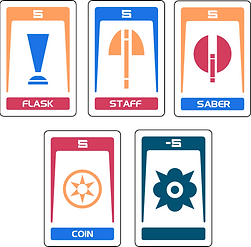
If any player draws a five card from the deck (The Five of Flasks, Five of Staves, Five of Sabers, Five of Coins, or the Fifth Aspect), they must immediately play it face up on the table. These cards are in the Stasis Field and immune to Shifting. They are also 'wild' in two senses:
— Table Cards: They become community cards and are factored into every player's hand.
— Choice of Value: Each card may be factored into a player's hand according to the value of +5, -5 or 0 by their choice. So a player may factor one card as +5, another as -5 and another as 0, in any combination they choose.

Additionally, if every available 5 card in the deck is played to the table before play reaches 5 rounds, this triggers the Five Brothers Win Condition. Play immediately ends, and players must reveal their hands.
WINNING THE HAND
The game continues until one of the following conditions is met:
— All Players Check: Everybody Checks instead of bets during the Betting Phase.
— The Five Brothers: All five of the Wild Five cards are played to the table.
— End of Fifth Round: Play continues to the conclusion of the fifth round.
Once one of these is met and the Shift Phase card has been drawn and added to the Array, the Shift result is determined and hands are assessed. If a shift occurs, the shifted hands are evaluated. If no shift occurs, hands are assessed as they are.
Players reveal their hands. Hand scores are ranked as follows:
THE DESPERADO
A version of The Idiots Array (see below) made entirely with cards from the Suit of the Major Aspect (0, -2 and -3). This hands beats a standard Idiot's Array, a Pure Sabacc and a Wild Sabacc. It collects the Hand & the Sabacc Pot.

THE IDIOT'S ARRAY
A special hand consisting of The Idiot (0) and any 2 or 3 card (to make a literal read of 23). This hands beats a Pure Sabacc and a Wild Sabacc. It collects the Hand & the Sabacc Pot.

PURE SABACC
A hand totaling exactly -23, 23 or 0 in Centran Sabacc. This hand wins the Hand Pot & the Sabacc Pot.
Negative sum (-23) beats positive sum (+23) and positive beats 0.


WILD SABACC
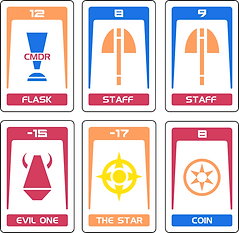
If the end of the game was triggered by the Five Brothers, the last player to play a Five to the table may score the Five Brothers as 0 for a Wild Sabacc (disregarding the other cards in his hand) if they do not hold a higher ranked hand.
The Five Brothers cannot beat a Desperado, Idiot's Array or Pure Sabacc of -23 or 23 but will automatically beat a Pure Sabacc of 0 and any Nulhrek hand. It collects the Hand Pot & the Sabacc Pot.
NULHREK
(Closest Hand to -23, +23 or 0)
If no one has a Pure Sabacc or Wild Sabacc, the hand with the closest alue to -23, +23, without bombing out, wins the Hand Pot.
When hands are tied for integer distance from a valid target, proximity to -23 beats proximity to +23, proximity to +23 beats proximity to 0, and a negative score close to 0 beats a positive score close to 0.


.png)
RECKONING WILD FIVES
(Examples from Play)

.png)

BOMBING OUT
Hands overshooting a score of -23 or +23 are considered 'Bombed Out' and are disqualified. Players with bombed out hands mst pay a penalty to the Sabacc pot.
TIEBREAKERS
In the case of a tie between hands, the following tiebrakers are applied:
1. Most Cards in Hand
2. Pairs Held
3. Most Cards in one Suit
4. Most Negative Cards
5. Highest positive integer card
CONCEDED HANDS
If a player wins the pot because the other players have all folded, not a card reveal, it does not matter what cards that player is holding - they will take the hand pot, but they cannot win the Sabacc pot, even if they are holding a Pure Sabacc or an Idiot's Array.
WINNING THE GAME
The game continues for a predetermined number of hands, or until only one player has credits left in their stock. The player with the most credits at the end of the game is declared the winner.