THE COMPLETE KESSEL SABACC
Want to learn how to play Kessel Sabacc? Use this page to find everything you need.
Kessel is a fresh and wildly popular new variant of Sabacc that has spread quickly through the card rooms and sabacc parlours of the Outer Rim. Distinct from older versions of the game, the mechanics of Kessel are said to be directly inspired by the oppressive economic regime of the Empire, and intended to evoke the precarious conditions of life under its heavy tax and regulatory burdens.
Appropriately, Kessel is a zero-sum game of attrition and diminishing odds in which players compete to outlast each other through successive hands to secure the prize pot. Rather than increasing their share of the stake by competing for chips, players instead lose ‘tax chips’ every time they fail to secure a winning hand. Only one player can secure the fixed pot at the end of the game.
The element of a shift or twist in fortune, integral to all Sabacc variants, is fulfilled by Shift Tokens: markers which can be played strategically to recover lost chips, penalise opponents, or even temporarily alter the victory conditions of a hand. One of the first major Kessel Sabacc tournaments was the Okala Five Sabacc Tournament, held aboard the underworld casino cruiser Morenia sometime between 7980 and 7981 CRC.
Navigate our Complete Guide to Kessel Sabacc
Under Rules - A complete breakdown of the game, including table setup, game components, gameplay structure and order, win and loss conditions, and hand hierarchies and tables, including re-ordered hierarchies when shift tokens are used.
Under Tutorials - A link to our interactive online tutorial, where you can learn to play Kessel Sabacc right now.
Under Variants - Find information about custom Shift Tokens created by the Sabacc community.
Under Sources - Documented sources for Kessel Sabacc in the Star Wars, including published materials and merchandise.
Under Downloads - Player Resources for playing Kessel Sabacc. Download a copy of the rules, printable Shift Tokens and our Communit Shift Token pack.
You can play Kessel Sabacc against AI or other players online using the Holocard Cantina App.

RULES FOR KESSEL SABACC
GOAL
In Kessel Sabacc, you receive two cards, then invest tax chips to improve your hand and get a matching pair: a Sabacc hand. To win a round, you need to have the best hand at the end of 3 turns.
The last player with tax chips in stock wins the game, and the content of the credits pot.
CARDS
The deck comprises 44 cards divided into two suits or families: Sand and Blood. Each suit contains:
-
18 positive cards valued from 1 to 6, with 3 of each value
-
3 Imposter Cards
-
1 Sylop Card
Though the Kessel Deck uses many of the same cards found in the 62 Spike deck, it is distinguished by the fact that the two suits or families in the deck have different colour card backs, which helps to set them apart for play.

The card value is depicted by its header and central symbol which represent Corellian numeral values. According to the design of the deck, the header may use Arabic numerals or a counting symbol.

HAND VALUE
The goal is to minimize your hand value. You are seeking to both match the value of your cards (a pair with 0 difference between them) and to get the closest value to 0.
A sabacc hand consisting of lower value cards is stronger, with a hand of 0/0 being the best card value, and 6 being the worst.

SPECIAL CARDS
Sylop Cards
When revealed, the Sylop will take the value of the other card in your hand, forming a pair and a Sabacc hand. This is known as a Sylop Sabacc. A pair of Sylops is a Pure Sabacc. There is 1 Sylop card in each suit or family.
Imposter Cards
When revealed, the player will throw a pair of dice and choose 1 of the values thrown. The Imposter takes on the value of the chosen dice, completing your hand. There are 3 Imposters per suit or family.
A Sylop Sabacc or Imposter Sabacc are equivalent to a standard Sabacc hand of the same value.
A pair of Sylops is a Pure Sabacc, and is the best hand in the game, unless it is counteracted by the effects of a Shift Token.
SHIFT TOKENS

At the start of each game, every player receives or selects three 'Shift Tokens'. Playing these Shift tokens can change the odds or even the rules of the game.
There are four different kinds of Shift Token: Stock Tokens, Tax Tokens, Fix Tokens and Trick Tokens. Each token type targets a different aspect of the game and can be used strategically to get an edge over opponents. In total there are 16 different Shift tokens. The tokens and their effects are are discussed later in these rules.
TAX TOKENS
In a lay game of Kessel Sabacc, the conversion rate between staked credits and tax tokens typically stands at 15 credits per tax token. A player stake of 60 credits buys 4 tax tokens, 90 credits buys 6, and 120 credits buys 8 tax tokens. A table of four players with 8 tokens yields a Sabacc pot of 480 credits.
In a pro game of Kessel Sabacc, the conversion rate between staked credits and tax tokens typically stands at 25 credits per tax token. A player stake of 100 credits buys 4 tax tokens, 150 credits buys 6, and 200 credits buys 8 tax tokens. A table of four players with 8 tokens yields a Sabacc pot of 800 credits.
In tournament games the conversion rate is typically 125 credits per tax token. 500 credits buys 4 tokens, 750 buys 6 tax tokens, and 1000 credits buys 8 tax tokens. A table of four players with 8 tokens yields a Sabacc pot of 4000 credits.
PLAYING THE GAME
Each game is played through consecutive rounds until one player wins. In each round, every player gets 3 turns. Each round concludes with the Reveal.
SETUP
1. Sabacc Pot: Each player contributes a stake to the Sabacc pot.
2. Player Stock: Each player receives a stock of 4-8 Tax Chips according to the intended length of the game and size of the stake.
3. Hand Pot: Each player has a Hand Pot. Whenever a player buys a card on their turn, they place a Tax Chip from their Stock into the Hand Pot. These chips are invested, and will be recovered or lost at the end of the Round.
3. Draw & Discard Piles: The card deck is divided into two suited piles of Blood and Sand - these are the Draw Piles. One card is drawn from each pile to start a corresponding Discard Pile for each suit.
4. Assign Shift Tokens: Players either select from an available stock of Shift Tokens, are assigned a predetermined selection, or receive a random selection of tokens.

SHIFT TOKENS
STARTING THE ROUND
1. Determine Starting Player — The starting player rotates clockwise each round.
2. Deal Cards — Players are dealt 2 cards, one from the each family of Sand and Blood.
CARD TURN
On their turn, player may:
1. Stand — Pass without drawing a card or investing any chips.
2. Draw a Card — A player may invest 1 Tax Chip to draw a card from the top of any of the Draw or Discard piles.
After drawing you must discard a card from the same family, always keeping one card of each family in hand. Discarded cards are placed on the Discard Pile of the corresponding Family.
Each round lasts 3 turns, giving you 3 opportunities to improve your hand.
Invested Tax Chips are placed in the player's Hand Pot for that round. Chips in the Hand Pot can be recovered at the end of the round.
PLAYING SHIFT TOKENS
At the start of their turn, players have the additional option to play one of their three Shift Tokens.
Shift Tokens have different effects which can be used to change the odds of the game, hopefully in your favour. For instance, the Free Draw token allows you to draw a card without investing a tax chip on that turn. Other Shift Tokens can have more dramatic effects, like changing the rankings of Sabacc Hands.
For a full listing of Shift Tokens and their effects, see the Shift Token section below.
Playing a Shift token is a free action: afterwards, the player can still draw cards or stand.

REVEAL
After each player has played 3 times, everyone reveals their hands. If every player stands during a turn, everyone reveals their hands. Hands are ranked according to the Hand Values listed above.
WINNING THE ROUND
The player with a pair closest to zero wins the round. The player who wins a round loses no tax chips. All of their invested chips in the Hand Pot are returned to their Player Stock.
Players who have a Sabacc hand but do not win will lose their invested chips, and are also taxed one chip from their stock.
Without a Sabacc hand, you lose your invested chips, and are taxed an amount equal to the difference of your card values.
All taxed chips are lost. These chips are placed out of play, and cannot be recovered.
If your chips stock is empty by the end of the reveal phase, you are eliminated from the game.
WINNING THE GAME
At the end of a round, if at least two players still have Tax Chips in their Stock, another round begins.
You win the game upon being the last player with chips in stock, and collect the content of the Sabacc Pot.
HAND HIERARCHY
In Kessel Sabacc, hand values are ranked according to the extent to which they minimise the value of cards in your hand.
SHIFT TOKENS
There are 16 officially recognised Shift Tokens used for games of Kessel Sabacc. These tokens are divided into four types: Stock Tokens, Tax Tokens, Fix Tokens and Trick Tokens. There are four types of each token.

STOCK
TAX
FIX
TRICK
STOCK TOKENS allow players to protect, replenish or otherwise extend their stock of Tax Chips. The four kinds of Stock tokens are:
Free Draw — Avoid the draw fee this turn. You may draw a card without investing a tax chip.
Refund — Return two taxed chips to your player stock.
Extra Refund — Return three taxed chips to your player stock.
Embezzlement — Take one tax chip from each player's hand pot and add it to your hand pot. These chips are invested - you must win the round in order to retain them.
TAX TOKENS allow a player to deplete their opponents stock of Tax Chips (without replenishing their own). The four kinds of Tax tokens are:
General Tariff — Other players are taxed one chip.
Target Tariff — Choose a player. They are taxed two chips.
General Audit — Other players in Stand are taxed two chips.
Target Audit — Choose a player in Stand. They are taxed three chips.
FIX TOKENS allow players to manipulate the win conditions of the round by changing the target hand value and/or hierarchy, or the value of cards in your hand. The four types of Fix tokens are:
Prime Sabacc — Roll two dice. Pick one value as the new Prime Sabacc. This places the selected value pair in the Prime Sabacc position. It does not overwrite a Pure Sabacc. Prime Sabacc can be overridden by playing another Prime Sabacc token.
Markdown — Nullifies the Sylop card until next reveal. The Sylop holds no value, and a Pure Sabacc ranks last amongst paired hands, even when Cook the Books is played. A Pure Sabacc will still rank over an unpaired hand.
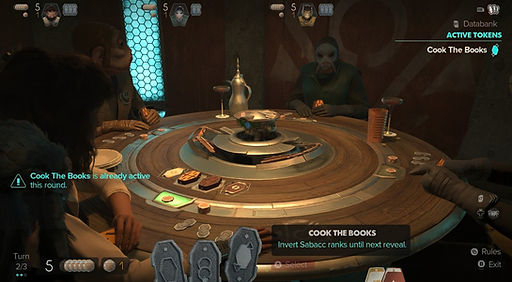
Cook the Books — Invert Sabacc ranks until next reveal. Cheap Sabacc (6/6) is the best Sabacc and Pure Sabacc (0/0) is the worst. Cook the Books cannot be countered with another Cook the Books token.
Major Fraud — Set Imposter value to 6 until next reveal.
TRICK TOKENS allow players to block, disrupt or otherwise interfere with the other player's cards and token actions. The four kinds of Trick tokens are:
Embargo — Next player must stand. They can still play a Shift Token as a free action.
Immunity — The player is immune to the effects of Stock, Tax and Disrupt Tokens until the reveal. They are not immune from the effects of Fix Tokens.
Exhaustion — Choose a player. They must discard and draw a new hand,
Direct Transaction — Choose a player. Trade hands with them.
HAND HIERARCHIES WITH SHIFT TOKENS ACTIVE
Different combinations of Shift Tokens can re-order the Hand Hierarchy. These example tables illustrate how different hands and tokens can interact.
.png)

.png)
.png)
.png)