
CREDITS
Designer: Michael Corry
Lore Design: IB-9D3
Playtesters: Brian H. Wilson, Cole Thronhill, Adrian Berger, Rick Scott
Graphics: Rick Scott
RULES FOR PAARGUS
Paargus was a game for 2 players developed by Corellian and Durosian spacers who pushed the frontier from their homes in the Coreworlds to Ord Mantell in the New Territories, during the colonial expansion of the Old Republic. The game plays upon the shifting conjunctions of interstellar bodies, variously identified with the stars of Duro or the moons of Ord Mantell as the game passed back and forth across the spacelanes.

CARDS
A Paargus Deck consists of 42 cards each of which is divided into 4 Quadrants. The 4 Quadrants are each marked with a Sigil, and each card is divided down the centre by a Meridian Line.
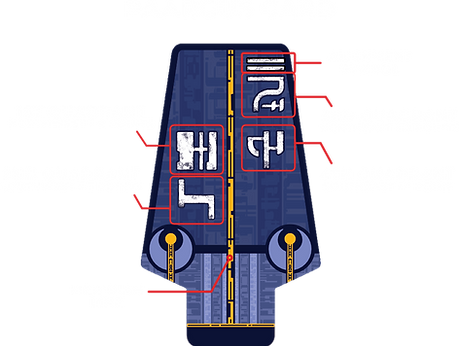
When cards are grouped together into sets—called Conjunctions—the cards are overlapped. The edges of overlapped cards are aligned with the Meridian Line, creating a fan-like arrangement. The arrangement of overlapping cards is important, as we shall see.

ASTRONOMICAL SIGILS
There are 14 distinct sigils. These sigils usually correspond to a set of astronomical objects, according to the theme of the deck. This Sigil Set depicts 14 of the 15 moons of Ord Mantell, excluding the 13th moon, Mirvon, which is considered bad luck. Other sets depict constellations in the night sky of Duros.

In addition, some cards also feature an Alignment Symbol that sits above one of the four Card Quadrants:

GOAL
The goal of a game of Paargus is to create Conjunctions. Conjunctions consist of a set of 3 or more cards with a matching Sigil in the same quadrant.
Players must also collect Conjunctions displaying an Alignment Symbol to trigger the end game - this is explained in further detail below.
The goal of the game is to accumulate conjunctions for points; trigger the end game by playing two Alignments to the table; and win by having two more valid Alignments in your Player Array than your opponent. The winning player scores their conjunctions to determine the payout owed to them by their opponent.
Further details are provided below.
SETUP
Draw Deck - A shuffled deck of 42 Paargus Cards.
Chip Stock - A stock of chips or coins representing the sum of a player's buy-in to the game.
Player Hand - Cards in the player's hand accumulate until played to the table as a valid Conjunction. Hand size may not exceed 6 cards at the beginning of a player's turn.
Sky Tableaux - Players can place cards from their hand onto the table. They become part of the Sky Tableaux. Any player can trade cards from the Tableaux with cards in their hand.
Player's Arrays - Cards which are played to the Table as Conjunctions are part of the Player's Array. At the end of the game, the Conjunctions in the Array are scored to determine the victor and their winnings.
.png)
GAMEPLAY
Play in Paargus proceeds as follows:
1. First Draw
On their first turn, players draw 3 cards and then places the Draw Deck between them. Hand size may not exceed 6 cards.
Which player goes first?
PLAYER ROUND
1. Play To Tableaux
A player may lay down any number of cards on the table as part of the Tableaux. Players may do this voluntarily, but they MUST play cards to teh table if the player's hand exceeds the limit of 6 cards, to reduce their hand down to a maximum of 6 cards.

2. Trade With The Tableaux
A player may trade a card from their hand with a card from the Tableaux. Cards which are traded MUST have a matching Sigil in the First Quadrant. The traded card takes the place of the card in the Tableau.

4. Draw A Card
A player will then draw a card from the draw deck. If the drawn card's First Quadrant Sigil matches 1 or more of the cards in the Tableaux, ALL of the matching cards are taken into that player's hand. This may cause a player to exceed their hand size.
.png)
5. Play A Conjunction
A player may lay down a single conjunction at the end of their turn.
Conjunctions initially must consist of a minimum of 3 cards. The cards must be overlapped so that the Sigils of one Quadrant are shown in sequence. The manner in which cards are overlapped can be significant, as it may display or obscure any Alignment Lines (see below).
West Sky Conjunctions (Quadrants 1 & 2, left of the Meridian) always consist of 3 cards only.
East Sky Conjunctions (Quadrants 3 & 4, right of the Meridian) must be played initially as 3 cards, but on each subsequent turn a single card with a matching Sigil and Quadrant may be added to the conjunction. Cards which added to a East Sky Conjunction are known as Trailing Cards. Trailing Cards are kept at a remove from the initial Conjunction for the purpose of correctly scoring Alignments (see below).

Alignments are made when any of the cards in your Conjunction are displaying an Alignment Symbol.
Alignment Symbols do not have to be in the same quadrant as the matched Sigils. When a set of cards are played together, only one Alignment Symbol can be counted in the same Quadrant. However, if a Conjunction is expanded with Trailing Cards, Alignment Symbols on these cards are scored even if they occur in the same Quadrant as another card in the Conjunction - this is because it is considered to be a distinct alignment occuring after the last alignment.
Players may also overlap their cards in such a manner as to hide the Alignment Symbol on a card. If a card in a Conjunction is overlapped so that it does not display its AlignmentSymbol, it is not scored as an Alignment. This allows players to make strategic decisions about whether or not to trigger the end game (see below).
After drawing and playing any conjunctions, play passes to the opposing player. They begin their turn by choosing any cards they wish to to play to the Tableau, and repeat the round order.
WINNING THE GAME
ALIGNMENTS
In order to begin the endgame, two Alignments—conjunctions with one or more Alignment Symbol displayed—must be played to the table. These two conjunctions may be played by either player or the same player.
Once two Alignments have been played to the table, it becomes possible to end the game by having two more valid alignments in your Player's Array than your opponent.
PLAY EXAMPLES

In this example, each player has laid one conjunction which display 3 sets of Alignment Lines in 2 Quadrants for a total of 2 valid Alignments. Players may now pursue the end game. When one player lays Conjunctions that include two more valid Alignments than their opponents, the game ends.
Note: Alignment Lines are only counted if they are in different Quadrants when a set of cards are played together. Two Alignment Lines in the same Quadrant equal only one alignment. In this example, Player 2 has two Alignment Lines in the North East Quadrant, which counts only for a single alignment. However, multiple Alignments in the same Quadrant are allowed in a Conjunction if they are on Trailing Cards.

In this example, the player has an East Sky Conjunction in the Fourth Quadrant, with an additional card laid in a subsequent turn. The hand scores 3 alignments: two alignments in the first Conjunction (the initial three cards) and 1 alignment in the trailing card. Although the later Alignment Symbol is the NE quadrant, which has already been used in the initial 3 card conjunction, Alignment marks in the same quadrant on trailing cards are counted. (This is because the trailing card represents a chronologically distinct conjunction). The hand scores 4 points (4 Sigils in the Fourth Quadrant - 4 x 1 Points) and 3 Alignments.
CONJUNCTION TOTAL
Play continues until one player has collected two more Alignments in their Player Array than their opponent. Players then score their cards.
SCORING
Conjunctions are scored according to the Quadrant their Sigils are aligned within.
First Quadrant (North West) - 4 Points
Second Quadrant (South West) - 3 Points
Third Quadrant (North East) - 2 Points
Fourth Quadrant (South East) - 1 Point
A conjunction's point value is the Number of Sigils x the Point Value of the Quadrant.
Remember that the West Sky Conjunctions are limited to 3 Cards, while East Sky Conjunctions can include any number of cards.
The losing player scores no points. The losing player must pay the equivalent value of their opponent's score in chips or credits.
The game is then concluded, or a new game begins. Players may continue until one player cleans the other out.
SCORING EXAMPLES
In order to begin the endgame, two Alignments must be played to the table. These two Alignments may be played by either player or the same player.

1 Set / 1 Conjunction
Three Matched Sigils in the First Quadrant (x4) = 12 Points

1 Set / Conjunction
Three Matched Sigils in the Fourth Quadrant (x1) = 3 Points

1 Set with 2 Trailing Cards / 1 Super Conjunction
Five Matched Sigils in the Fourth Quadrant (x1) = 5 Points

1 Set / 1 Conjunction
Three Matched Sigils in the Second Quadrant (x2) = 9 Points
CONCEPT LORE: THE MOONS OF ORD MANTELL
Ord Mantell has 15 satellites, two of which are classified as moons. The large twin-moons, Nalatxa and Quantxi, orbit closely to Ord Mantell and can be seen prominently during both day and night. The satellites are named for characters from the Old Corelli story of Mantell.






INNER MOONS (Uhl Klostu Lynei)
Nalatxa
The larger of the two moons, Nalatxa is arid and its surface is pocked with large craters. Named for Mantell’s mother.
Quantxi
Quantxi as a reddish hue from above. As a terrestrial moon it has been inhabited by various factions over time. Today it is used as a scrapyard. Named for Mantell’s father.
Notably, neither of these names are derived from Old Corelli words. Their etymology is unknown, and they may predate colonization.
OUTER MOONS (Uhl Ehinseit Lynei)
Ertila
Named for the first daughter of Mantell.
Igraan
Named for the second daughter of Mantell.
Leda
Named after Mantell’s mortal mother; wife to Andral. Leda and Andral appear almost entwined with each other’s orbits, barely apart in the sky.
Andral
Named after Mantell’s mortal father; husband to Leda.
Turhaya
Means ‘bright star’. Turhaya can be seen in the early morning skies over Ord Mantell. Turhaya appears stationary but is not in a fixed orbit, its placement varies by 8-11° each season.
Chryas
An Old Corelli mythical figure known for his wisdom.
Quore
Named for the first son of Mantell.
Quoval
Named for the second son of Mantell.
Pryarios
The smallest of Ord Mantell’s outer satellites. Pryarios has a dense silicate atmosphere that ignites in colorful lights when debris and dust passes through it. Associated with the natural mysteries (‘the Force’). In Old Corelli mythology, Pryarios was a hermit and wizard who tutored Mantell in her youth.
Eharlon
Meaning ‘trickster’; the son of Andral and Leda, brother of Mantell. Known for his misanthropy and mischief. Eharlon's orbit is often aligned behind Pryarios, who in Old Corelli mythology, contained Eharlon in a prison of magik.
Mirvon
Ord Mantell's 13th moon. Its etymology is unknown, but is believed to be derived from a malevolent entity associated with bad dreams in Old Corelli mythology. Its proximity to Eharlon keeps it in almost complete darkness. It is often thought to be unlucky to utter or depict the moon, leading to its exclusion from the game of Paargus.
Yugan
Also known as the dog moon. Yugan was the faithful companion of Mantell. It's orbit crosses with Guerllon every 5 years, so that they switch places: two devoted guardians exchanging watches.
Guerllon
Guerllon is co-orbital with Yugan, switching orbits every 5 years. Guerllon is known as the Sentry Moon, watching over Ord Mantell from the last reaches of her orbit. Named for the messenger of Quantxi and Nalatxa, who was sent to keep watch over Mantell in her mortal life.
