
Rules for DEADMAN'S BINSPO
Deadman’s Binspo was played by Saw Gerrara's Partisans in their hideout in the Catacombs of Jedha according to the Rogue One: Ultimate Visual Guide. Our version of this game imagines is as a gambler’s card game in which players are forced to sacrifice cards and chips to play their way through three suits of a Deadman’s Sabacc Deck, and come out on top with the best hands and the biggest pile of credits.
The game is patterned on an old story—a traveller’s tale told in the streets of Jedha and in the galaxy at large. It speaks of a doomed pilgrimage that lasted three weeks, three months, or three years, depending on the storyteller, but always turns on three pivotal days. They were led there by one man, who had seen a vision promising the secret of eternal life. On Day One, the pilgrims journey into the mountains. On Day Two, they see the moons rise, mirrored in the silver lakes. On Day Three, the sky turns black and the moon bleeds red. Each night, they must sacrifice part of their food to feed the communal pot of Binspo soup—but despite their offerings, more and more of them are found dead in the morning.
They say that only one man survived by the final day, the day of the Blood Moon — the man who had seen the vision, now the only one left, clutching all that was left of the food shared by the other pilgrims: the deadman’s binspo.
CARDS
The deck used follows the form of a 62-card Sabacc deck, but uses an extra Sylop or 'Void' card for 63 cards total. The deck uses three primary suits. Each suit is split into two mirrored subsuits of cards numbered 1-10. There are also 3 zero or void cards, which have a special function in the game.

GOAL
The goal of Deadman's Binspo is to hold the best hand of four cards when the Binspo (Sylop or Void Card) is played.
Each player has the chance to improve their hand on their turn by choosing a card to pass to another player.
At the end of each turn around the table, players will be obliged to pay a Tithe to the Binspo Pot equal to the card discarded by the final player. The game uses the three suits as separate draw decks for three consecutive stages of play - The Mountains, The Rising Moons and The Blood Moon.
SETUP
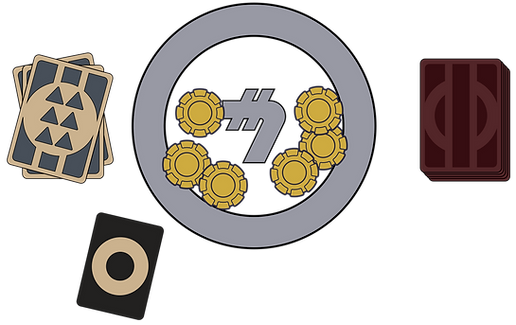
Three Draw Piles - The draw deck is divided into three piles according to the three primary suits. Each pile contains the positive and negative cards in that suit, and one Binspo card per draw pile.

Day 1: The Mountains - Triangles
Day 2: The Rising Moons - Ovals (or Squares if not using the Deadman's Deck)
Day 3: The Blood Moon - Circles
Begin with the Stage 1 Draw Pile, and place the other two aside until needed.
Binspo Pot - The Binspo pot collects player antes and tithe payments made during the course of play.
Tithe Pile - The last player in the current round will play a card to the Tithe pile, which sits next to the Binspo Pot.
Chipstock - Player's bank of credits or play chips.
GAMEPLAY
1. Ante
A dealer is chosen. They take the Day 1 Draw Pile and shuffle the cards. They may set an optional ante for the Binspo Pot.
2. Deal
Four cards are dealt to each player. Play begins with the Dealer and proceeds clockwise around the table.
3. Player Turn
On the first player's turn they draw a single card from the current Draw Pile. They then choose any card they hold (including the one just drawn) to pass to the player on their left. Play passes to that player, who must choose one of the five cards they have in hand to pass to the next player on their left, until the last player, who instead of passing a card, must Set the Tithe.

On their turn, each player receives a fifth card. The first player draws the card from the Day Phase Deck; the other players will receive it from the player on their right.
After evaluating their hand, players choose one of the five cards to pass to the player on their left, bringing their hand size back down to 4. The last player to choose a card does not pass it to a player, but instead uses it to set the Tithe for that round.

4. Paying the Tithe
The last player to receive a card, instead of passing one of their cards will instead choose one card to Set the Tithe.
The card selected is played face up to the middle of the table and becomes the Tithe Card.
All players (including the one who set the tithe) must match the value of the Tithe card in one of the following ways:
1 - Play a card of equivalent or higher value face up to the table. This card will be visible to others players, and it cannot be passed, swapped or exchanged after it is played. It is however still a part of your hand, and counts toward hand value and ranking.
2 - Pay the equivalent value in chips or credits to the Binspo Pot.
3 - Play a card of lower value to the table, and pay the difference in chips or credits to the Binspo pot. This card will be visible to others players, and it cannot be passed, swapped or exchanged after it is played. It is however still a part of your hand, and counts toward hand value and ranking.

EXAMPLE
In this example, the card placed on top of the Tithe Pile is a 6 card. The top left player matches the tithe with a 6 card, and doesn't need to pay any chips. The top right player fulfils the tithe by by playing a 2 card to the table, and making up the difference of 4 with chips from his chipstock. The Bottom right player plays a 7 card to the table, which is a greater value and easily covers the tithe. The bottom left player chooses not to play any cards from their hand to the table - instead, they pay 6 chips to the Binspo pot to cover the tithe.
5. Begin a New Round
After Paying the Tithe, a new round begins. The first player of the last round will pass the current Draw Pile to the player on his left, thus becoming the last player who will set the tithe when the round ends.
Play proceeds around the table with the first player drawing a card, the other players passing one card to their left, and the last player setting the tithe. When another round begins, the first player passes the Draw Deck to the left and the sequence begins again with a new first and last player. This continues until the current Day Phase ends.
5. Calling Binspo
A 'Day' ends when the last card of the suit is drawn and passed around the table, or when somebody chooses to play the Binspo Card.
Each Draw Pile contains a Void (or 'Binspo') card. When the Binspo card is played to the table during the Tithe stage, the Day Phase is immediately over and players compare hands.
The Binspo card must be played during the Tithing action, but it can be played at at any point during a Day Phase -- it can be played early on, or a player may hold on to it until the last card of the suit is drawn, when it MUST be played at the Tithing stage.
When the Binspo is played, all players reveal their hands and the best hand wins the Tithe that has accumulated in the Binspo pot.

5. Winning the Day
The best four-card hands are as follows:
1. Two Pair - If players are tied, the highest pair wins (not the combined value of the pairs)

2. Suited Run - Three cards of consecutive value in matching colours (subsuit). Mixed subsuits - positive and negative cards - do not count as a run. Ties are broken by the highest value run.

3. Single Pair - If tied, the highest pair wins

4. Highest Hand Value - If nobody has pairs or a run, players tally up the value of the cards in their hand (and on the table). The highest value hand wins.
5. Begin a New Day Phase
After a Day Phase ends, all cards in hand and on the table from the current Draw Pile are removed from play. The winner of the previous phase is now Dealer. They take the next Day Phase Draw Pile and deal a new hand of four cards to each player to begin the next Day.
CONCEPT LORE: BINSPO
A search of the Celebratus Archive on Obroa-skai returns numerous entries for the word 'Binspo' in the galactic linguistic database. Determining a single origin point is difficult; the phonemes appear to have developed independently in multiple languages across disparate systems. However, the most prominent and recurring meanings of Binspo tend to cluster around the ideas of share, tithe, or portion. This suggests that the most likely meaning behind the game’s title is “The Deadman’s Portion.”
Additional linguistic traces connect Binspo with communal food cultures—particularly soup and dishes associated with collective survival, such as “forever stew” or ongoing broths kept warm and topped up continuously over time. In this context, Binspo is not only sustenance, but symbolic life-force.
Across many cultures and faith traditions, the act of offering a portion—whether of food, energy, or wealth—is a sacred gesture, a form of sacrifice or restitution for drawing from the natural or supernatural world. The Binspo legend, and the game that emerged from it, reflects these ritual dynamics—but also their darker ambiguities.
Central to the tale is the leader or prophet who guides the pilgrims into the wilderness. Despite repeated sacrifices to the communal pot, the pilgrims die one by one—until only the leader remains, clutching the final serving: the Deadman’s Binspo. This hints at something unsettling—the charismatic leader who abuses the generosity of the community to take from them. In this reading, the legend and the game channel cultural anxieties about spiritual authority, parasitic leadership, and the shadow side of communal devotion.
—Dr. Vexano Malorum, Department of Syncretic Mythologies, Hedrett Institute for Cultural Inquiry, Arkania
WINNING THE GAME
Play proceeds until the last Day, 'The Blood Moon' is complete. The player who has amassed the most 'Binspo' in his personal stock wins the game.
